The firefly's light as unreachable memory
Blind Willow, Sleeping WomanThe firefly’s light becomes an image of memory that remains present after the thing remembered has vanished, yet cannot be retrieved or held. On a dormitory water tower, the narrator releases a dim firefly into the night; its brief flight leaves a trace within him, but when he reaches toward that trace, his fingers meet nothing. The scene makes memory neither a reliable record nor a possession, but a fading impression whose persistence does not make it recoverable.
The Firefly and the Uncertain Memory
The narrator watches the firefly glow faintly at the bottom of a jar and wonders whether it is weakening or dying. Its light does not match his recollection of fireflies as bright points cutting through summer darkness. He considers another explanation: perhaps the light was never so bright, and what has changed is his memory. The surrounding darkness of childhood might also have been deeper. He cannot settle which explanation is true, and cannot remember when he last saw a firefly.
What he can call to mind is a scene rather than a date or place: water running at night through an old brick sluice gate, a narrow stream covered with plants, and fireflies gathering above still water. In that recollection, their yellow light seems to blaze and shine on the water. Yet when he asks himself when and where this happened, he has no answer. The remembered image is vivid enough to return but too detached from its circumstances to become a secure account of the past.
A Scene of Release
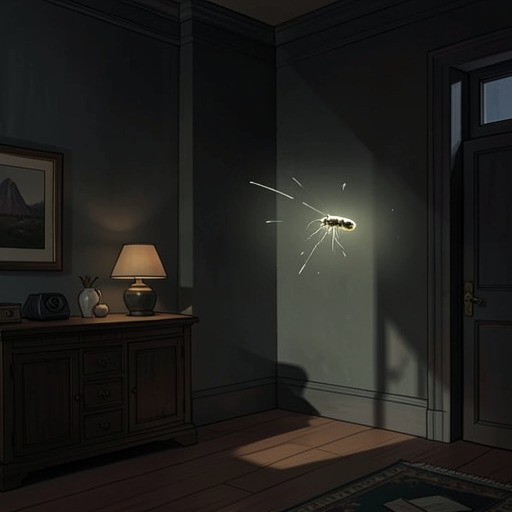
At night the narrator carries the jar to the dormitory roof and climbs a rusty ladder to the water tower. After watching the firefly, he opens the jar and sets it on the tower’s edge. The insect moves uncertainly over a bolt, tries one direction, reaches a dead end, and turns back. It remains motionless for a time before finally taking flight, rising over the railing, tracing an arc beside the tower, and heading east.
The release does not restore the brightness of the remembered swarm. The firefly’s light is dim, and its departure is brief. The narrator waits long after it disappears, but what remains is not the insect itself or a recovered childhood scene. It is the faint trail of light that has lodged in his mind. The movement from jar to open sky gives the episode its central contrast: the firefly can be released, and its light can be seen, but neither action brings the past back into possession.
An Unreachable Trace
After the firefly has vanished, its light continues to wander within the narrator, like a lost spirit in the darkness behind his closed eyes. He reaches his hand toward that darkness again and again, but touches nothing. The gesture gives physical form to the distance between carrying a memory and recovering what it refers to. The trace endures, yet remains just beyond reach.
The scene therefore holds uncertainty rather than resolving it. The narrator cannot tell whether childhood fireflies truly shone more brightly, whether childhood darkness made them seem brighter, or whether memory has altered what it preserves. The remembered stream and the present insect do not combine into a single, complete recollection. Instead, the past returns in fragments—a sluice gate, water, yellow light—while its time and location remain unknown.
Memory, Time, and Loss
The firefly’s departure gives the image a temporal shape: a light appears, recedes, and leaves an afterimage that lasts beyond its source. That afterimage is not the same as the lost experience. The narrator can still reach toward it, but his repeated reaching confirms that no effort makes the remembered scene whole again. The episode distinguishes persistence from recovery: memory can continue to affect the present without restoring the past as it was.
Across the book, this private uncertainty sits beside accounts of lives marked by historical change and loss. The narrator describes his generation’s entry into adulthood amid the student movement and calls the era his personal “A Pre-History of Late-Stage Capitalism.” In a separate family history, Shozaburo Takitani returns to Japan after imprisonment and discovers that his parents died in the Great Tokyo Air Raid and his brother disappeared in the war. Officer Sakata recounts how his brother was killed in the Second World War and how the loss changed their mother. These histories make the firefly’s small, elusive trace resonate beyond childhood recollection: private memory bears the past forward, but cannot undo absence or make every loss fully knowable.